






Manual Accessibility Adjustments with AI Support: How to Work Smarter with WCAG
AI cannot solve your entire digital accessibility with the push of a button, but it can become your absolute best tool in the process. By combining human judgment with smart AI support, you can drastically speed up your work with WCAG. In this article, we will go through how to use AI as an effective assistant to group deficiencies, write accurate alt-texts, and generate concrete code suggestions. You save time and avoid guesswork, while your team retains full control over what actually ends up in the source code.
PTS reviews e-commerce: this is checked and how to prepare your website
This is no longer just a theoretical reminder – The Swedish Post and Telecom Authority (PTS) has initiated its first actual review of Swedish e-commerce services to check compliance with the new accessibility law. The authority has already opened several supervisory cases focusing on three critical areas: the homepage, the search function, and the product pages. Failures in these areas could, in the worst-case scenario, lead to injunctions and penalty fees. We will go through exactly what PTS is looking for and provide you with a concrete checklist so you can secure your website before it's your turn.
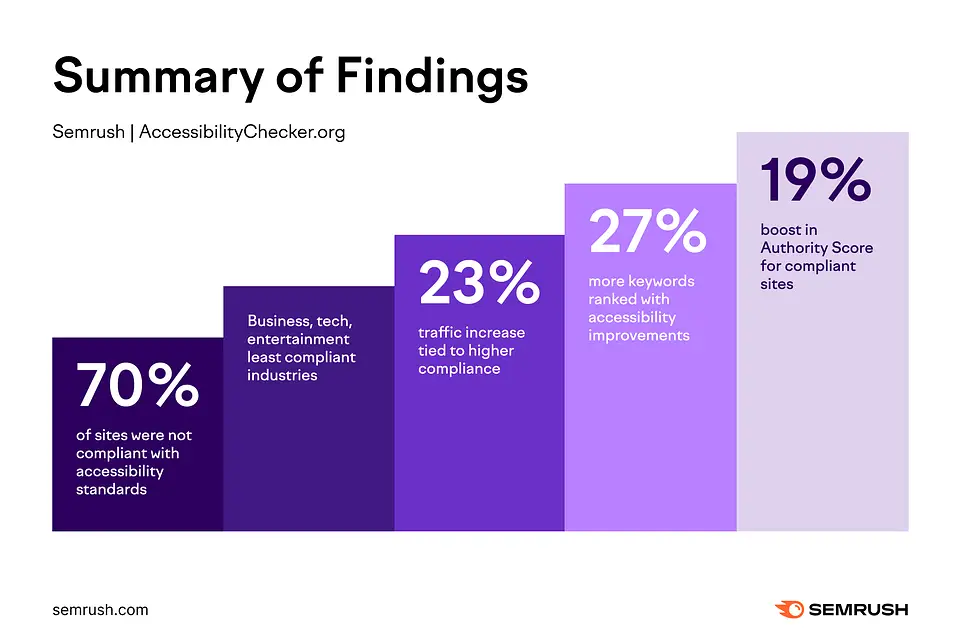
Accessibility Brings 23% More Organic Traffic—Here’s How WCAG Boosts Your SEO
Clear Connection Between Accessibility and SEO Semrush, together with AccessibilityChecker.org and BuiltWith, has examined how WCAG compliance relates to search engine visibility. The results specifically point to three effects: Why Web Accessibility Improves SEO What makes a website easy to use for people with disabilities often also makes it easier for Google to
EU Accessibility Directive 2025: A Guide for Swedish Companies
This text serves as a guide for Swedish companies preparing for the implementation of the EU's Digital Services Directive (European Accessibility Act) on June 28, 2025. The directive aims to make digital services and products, such as e-commerce, banking, transport, and telecommunications, accessible to everyone, including people with disabilities. The text explains which businesses are affected and provides a step-by-step guide to prepare. Key steps include conducting an accessibility analysis (mentioning tools like Selma.se), basing work on the WCAG 2.1 standard, training the team, and using tools for ongoing monitoring. If companies fail to comply with the regulations, they risk fines, sanctions, and lost business, while accessibility efforts can lead to more customers and an improved user experience.
Accessibility Expert Review: How a Manual WCAG Audit Is Done
Expert review of accessibility: how a manual WCAG audit is performed An automatic scan is a good start, but it's not always enough to determine if a website is accessible in practice. This requires an expert review (manual accessibility audit): a structured review where the website is examined against current WCAG requirements and key user flows are tested.
Keyboard Navigation and Focus: The Foundation of an Inclusive Website
Keyboard Navigation and Focus: The Foundation of an Inclusive Website One of the fastest indicators of whether a website is inclusive is simple: can it be used without a mouse? For many users, the keyboard (or keyboard-like assistive technologies) is the primary way to navigate. If focus disappears, jumps incorrectly, or gets stuck in a modal, then